An agent that reads SEC filings so nobody has to.
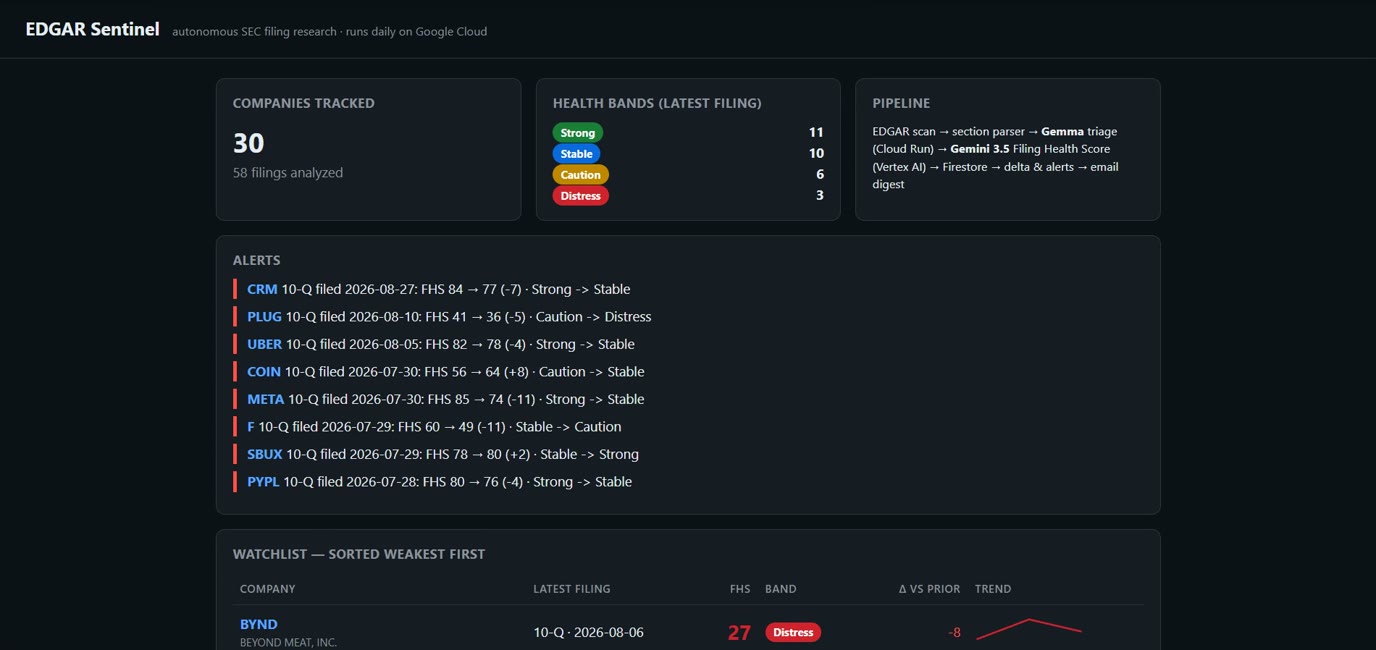
Every morning EDGAR Sentinel finds new 10-K and 10-Q filings, reads them with a two-model pipeline, compares each one with the company's previous filing, and emails what changed.
We built it in three weeks for Google Cloud's All Things Agentic Hackathon and left it running. It has run every morning since August 14, 2026, on the same stack we build for clients.
Every quarter, public companies file 10-Qs and 10-Ks, dense documents almost nobody reads end to end. The signal is specific and buried: a margin turning, new risk-factor language, a going-concern sentence on page sixty. Most businesses have a version of this pile, and the same pattern applies to contracts, inspection reports, and regulatory bulletins.
What it does at 6:30 Pacific, with nobody watching.
Scan
Cloud Scheduler starts a Cloud Run job. An orchestrator agent built on Google's Agent Development Kit checks SEC EDGAR for new filings from a thirty-company watchlist, identifying itself and respecting the rate limit, then archives the raw documents to Cloud Storage.
Read
A parser slices each filing into its sections, surviving the quirks of inline XBRL. Gemma, a small open model on a private Cloud Run service, writes terse triage notes on the risk factors. Gemini 3.5 on Vertex AI then scores the filing on five pillars with cited reasons, as schema-enforced JSON at temperature zero.
Remember and compare
Every analysis persists in Firestore. Each new filing is compared with the company's previous one, pillar by pillar. A threshold rule you can read decides whether that is an alert, and Gemini writes the short “what changed” narrative.
Deliver
An email digest, alerts first. A public read-only dashboard with health bands, trend lines, and a drill-down that shows every pillar's reasoning, the quarter-over-quarter change, and Gemma's notes.
The same habits we bring to client work.
It holds up outside the demo
The schedule has fired every morning since August 14 with nobody watching. Each filing is processed in isolation, so one bad document is logged and skipped instead of stopping the run.
Every answer is auditable
Scores are five pillars with cited reasons, recomputed in code. Alerts come from a threshold you can read, not from how the model felt that day.
Least privilege, by default
Three service identities, each with only what it needs. The one secret lives in Secret Manager. Nothing sensitive in the code, the image, or the repository.
Under four minutes, live on Google Cloud.
The demo starts the job on camera and comes back for it finishing: the Cloud Run execution, the console, the digest arriving, the dashboard updating.
EDGAR Sentinel produces automated research summaries from public SEC filings. It is not investment advice. Built for Google Cloud's All Things Agentic Hackathon and submitted on behalf of ASI. Judging runs through October 2026.
The same pattern, on your documents.
Contracts, inspection reports, supplier bulletins, regulatory notices: anything that changes quietly and matters when it does. Bring the pile and we will tell you what it would take.
Prefer email? contact@asisystems.io